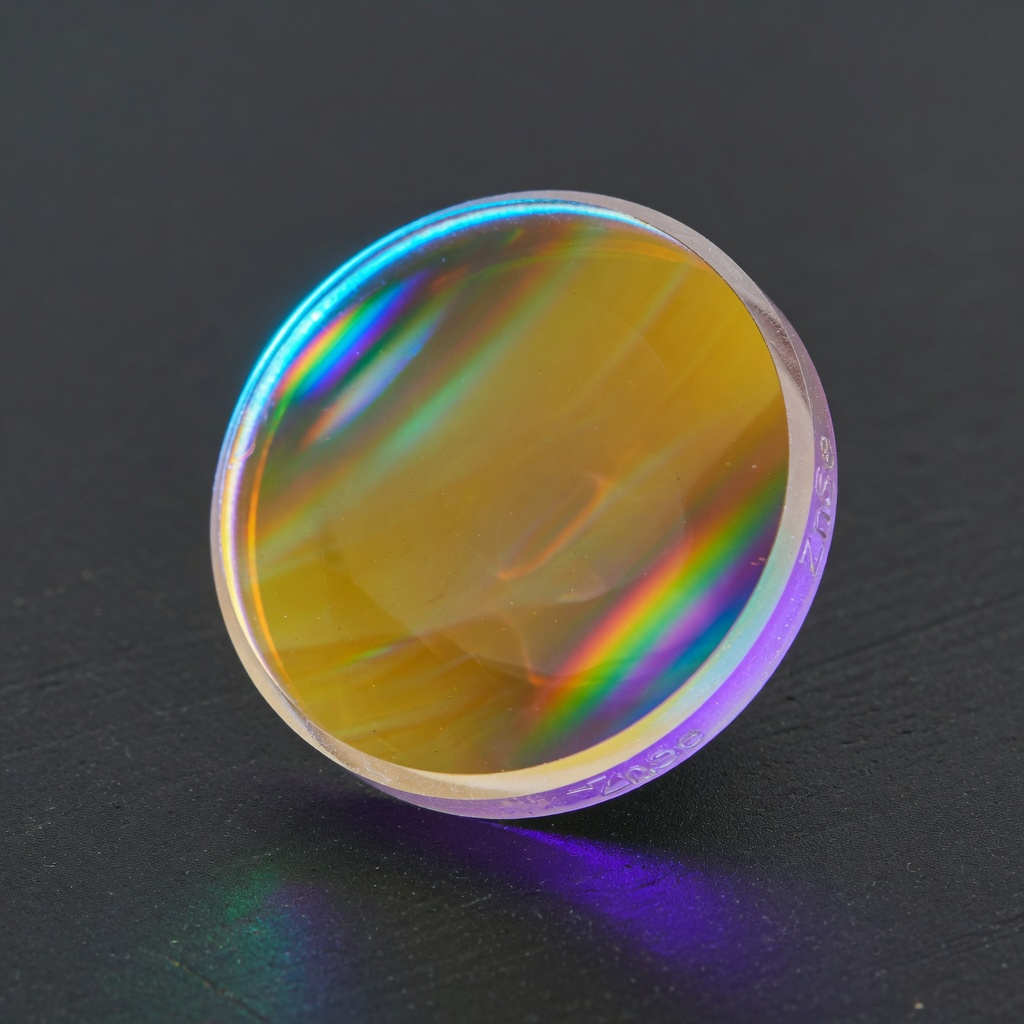
ZnSe · Zinc Selenide
Zinc Selenide
CVD-grown, laser grade with ≤ 80 µm inclusions. Very low absorption at 10.6 µm makes
it the default focusing and window material for CO₂ systems, and its visible
transmission gives you a red alignment channel through the same optic.
- Transmission0.6 – 21 µm
- n @ 10.6 µm2.4028
- Density5.27 g/cm³
- Knoop120 — soft
Handle with care: the low hardness means fingerprints and aggressive cleaning
leave permanent marks. Specify AR both surfaces for a real transmission gain.
Ge · Germanium
Germanium
The highest refractive index of the common IR set, which buys you shorter, more
compact lens designs. Opaque in the visible, so alignment must be handled on a
separate path.
- Transmission2 – 14 µm
- n @ 10.6 µm4.0032
- Density5.33 g/cm³
- Knoop780
Thermal runaway: transmission degrades sharply above roughly 100 °C.
Tell us the operating temperature at quote so we can flag it before you design it in.
Si · Silicon
Silicon
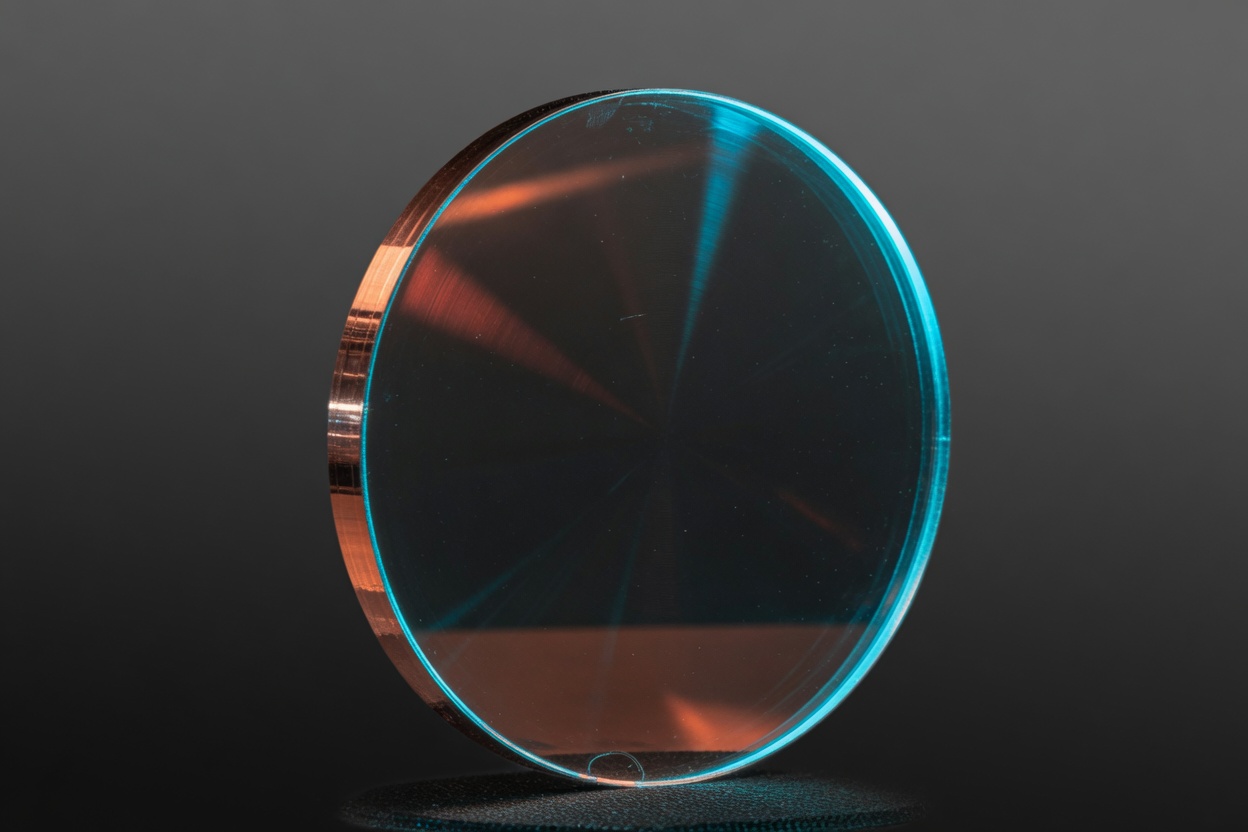
Less than half the density of germanium and a much better thermal conductor —
the right call whenever mass or heat dissipation drives the design. Also our
standard blank for laser mirror substrates.
- Transmission1.2 – 8 µm
- n @ 5 µm3.4223
- Density2.33 g/cm³
- Knoop1150 — hard
Note the strong lattice absorption band near 9 µm — silicon is a MWIR material,
not an LWIR one.
GaAs · Gallium Arsenide
Gallium Arsenide
Mechanically robust with a high damage threshold — chosen for high-power CO₂
delivery optics and protective windows that live in dirty, high-flux environments
where ZnSe would not survive handling.
- Transmission1 – 15 µm
- n @ 10.6 µm3.278
- Density5.32 g/cm³
- Knoop731
ZnS · Zinc Sulfide
Zinc Sulfide
Available as Cleartran® and multispectral grades. The unusually wide window —
visible right through long-wave IR — makes it the natural substrate for dual-band
assemblies that must image and align through one element.
- Transmission0.4 – 14 µm
- n @ 10.6 µm2.2008
- Density4.09 g/cm³
- Knoop160
AMTIR-1 · Chalcogenide
Chalcogenide Glass
A germanium–arsenic–selenium glass with a very low thermo-optic coefficient. If a
thermal imager has to hold focus across its whole operating temperature range without
an active compensation mechanism, this is how it is done.
- Transmission0.7 – 12 µm
- n @ 10.6 µm2.5109
- Density4.40 g/cm³
- AdvantageAthermal · mouldable